Blue Pioneer Consulting launched its first website on HubSpot ten weeks after kickoff
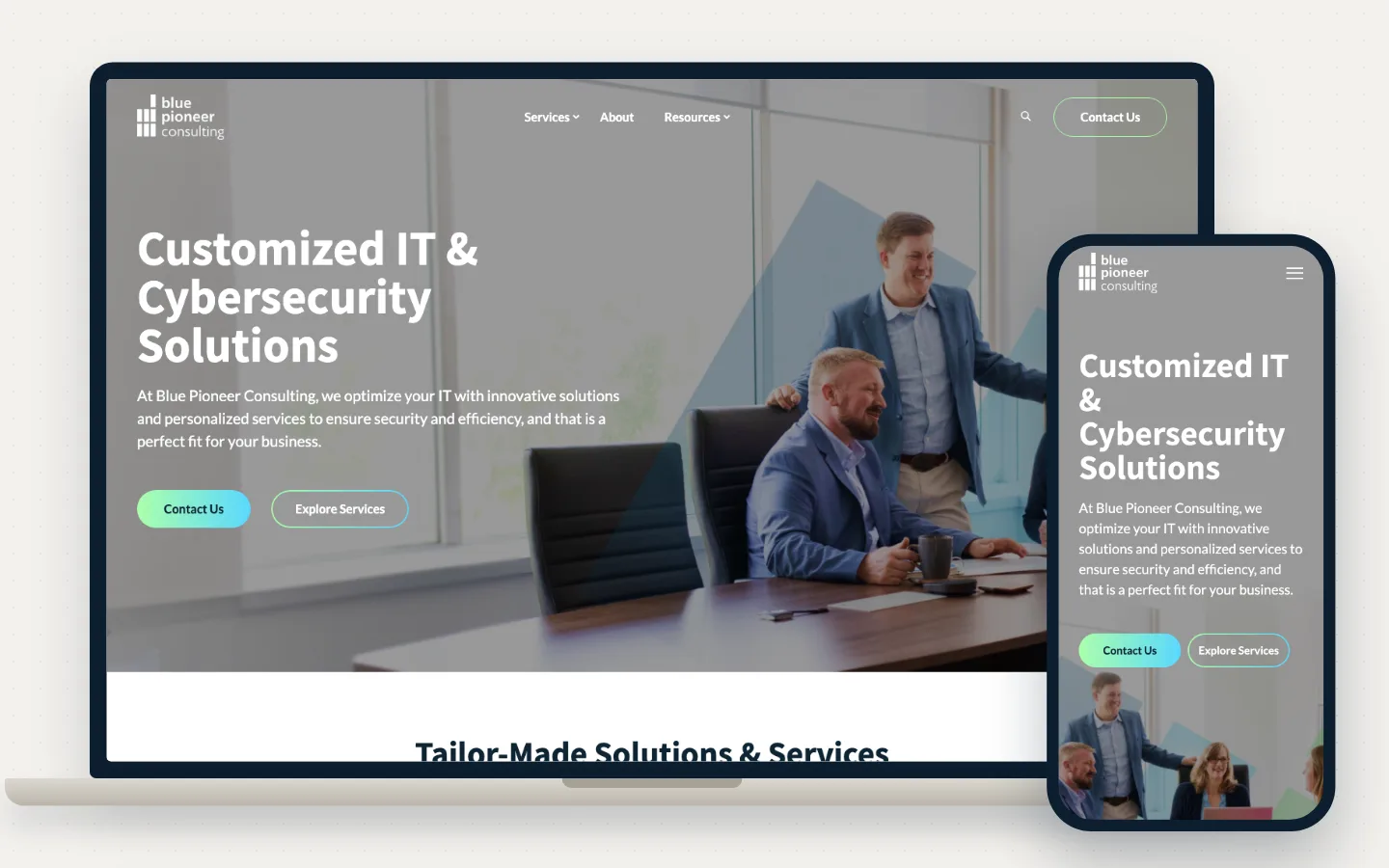
The Customer
Blue Pioneer Consulting is an IT consulting and cybersecurity firm serving businesses in Ohio, Kentucky, Tennessee and Indiana. It was formed as a joint venture between Blue & Co., a CPA and advisory firm, and Pioneer Technology, and it sells four services: cybersecurity, IT assessments, professional services and IT support.
When the firm came to Lynton in May 2024 it had a brand guide, some drone and office footage, and no website.
The Challenge
A new company has to look established on the day it opens. Blue Pioneer wanted all of its main pages live by the end of July, which left about ten weeks from kickoff to launch.
The team had a clear sense of tone. The site should feel clean, professional and techie but understandable, with some movement, and it should steer clear of the mascots and adventure imagery common in the cybersecurity industry.
Because two parent companies were behind the venture, the copy had to represent both teams, so each felt included and heard. And since the firm expected to add services and pages over time, it needed templates it could build on without calling an agency.
The Solution
We built the site on Lynton’s starter theme for HubSpot CMS, with every template designed from the brand guide and reviewed by a developer, a designer and a cross-browser tester before it went to the client.
Copy came first. We held two interviews with the firm’s subject-matter experts and wrote the pages from them: the homepage, About and Contact, and a page for each of the four services. Keyword research for the four service lines across the four states recommended city-plus-state search terms over state-level ones.
The header carries a Services mega menu with an icon and a short description for each service, an About link, a Resources menu for the blog, case studies and glossary, and a Contact Us button. The footer has room for the firm’s accreditation badges.
The homepage has a static hero with responsive background images, an auto-scrolling slider of feature cards, an address block and a tabbed module with light and dark versions and a secondary call to action. The flexible interior template holds more than a dozen modules, including two hero variants, a page navigation module, two-column image and text, horizontal tabs, icon grids, collapsible content, video, related resources and a form. We used it for the services listing and every service detail page, and it serves as the kit the team pulls from for new pages.
The About page introduces the partnership with a graphic of the two parent companies, a call-out for the firm’s service philosophy, an image grid, a video modal, a logo slider for affiliates and a stats module that collapses to a two-by-two grid on phones. The Contact page shows both office addresses on a map, and a landing page template with a simplified header lets the team build campaign pages themselves.
Two sections run on HubDB, the platform’s database tables. The resources library is built to list content with filters, search and pagination. The glossary has A-to-Z navigation, search and a filter for services definitions and technical definitions, and each term can carry inline links and its own call to action. The blog has topic filters, a tags module and a categories sidebar that links to pre-filtered results.
We drew custom icons for the four services and the ten industries the firm serves, from agribusiness to senior living, and delivered them as PNG, SVG and Illustrator files so the team can reuse them in other collateral. A Data Analytics icon followed for a service planned for later.
We entered 15 pages, handed the team a website workbook for testing, worked through two rounds of their feedback, and trained them for an hour. The site launched on August 1, 2024. Shortly after launch we added a job openings module that reads the parent company’s careers table, filtered to Blue Pioneer positions, so the new firm’s jobs appear on its own site from the same table.
What They Got
A company with no website in May had a complete one in time for its launch window, with a services section, an About page that explains the partnership, a glossary and a resources library that can grow with the firm.
The team can build landing pages, add a service page, publish a blog post or add a glossary term without a developer. The icon set is theirs to use across print and presentations.
Wrapping Up
The standard on this job was to hit a fixed launch date without skipping the checks: every template passed code review, design review and testing on physical and emulated phones and tablets before the client saw it. Lynton now builds AI-native websites on open infrastructure; see our current work at /case-studies.