Fitness 19 rebuilt its online joining checkout on HubSpot with live ABC Financial prices
The Customer
Fitness 19 runs a chain of gyms across California under two brands, Fitness 19 and Vim + Vigor Fitness. Each brand has its own website on HubSpot CMS, both built and maintained by Lynton. Membership billing runs on ABC Financial, and a plan sync Lynton had built earlier brings every location’s plans and prices from ABC into HubSpot on a schedule.
The site’s most important page is the one where a visitor joins. Every membership sold online is one the front desk can skip.
The Challenge
Sales ran at dozens of locations at once, and each one needed a banner, a struck-through base price and often a promo code. The marketing team wanted those details to be theirs to manage.
The client also wanted the flow itself redesigned, and the per-club links their emails already used had to keep working on the new page.
In 2025 the client decided to move its sales process off GymSales and into HubSpot. That brought two needs the website had to meet: a waiver a new visitor could sign at a kiosk or on a phone, and a way for a lead to book a gym tour from a text message.
The Solution
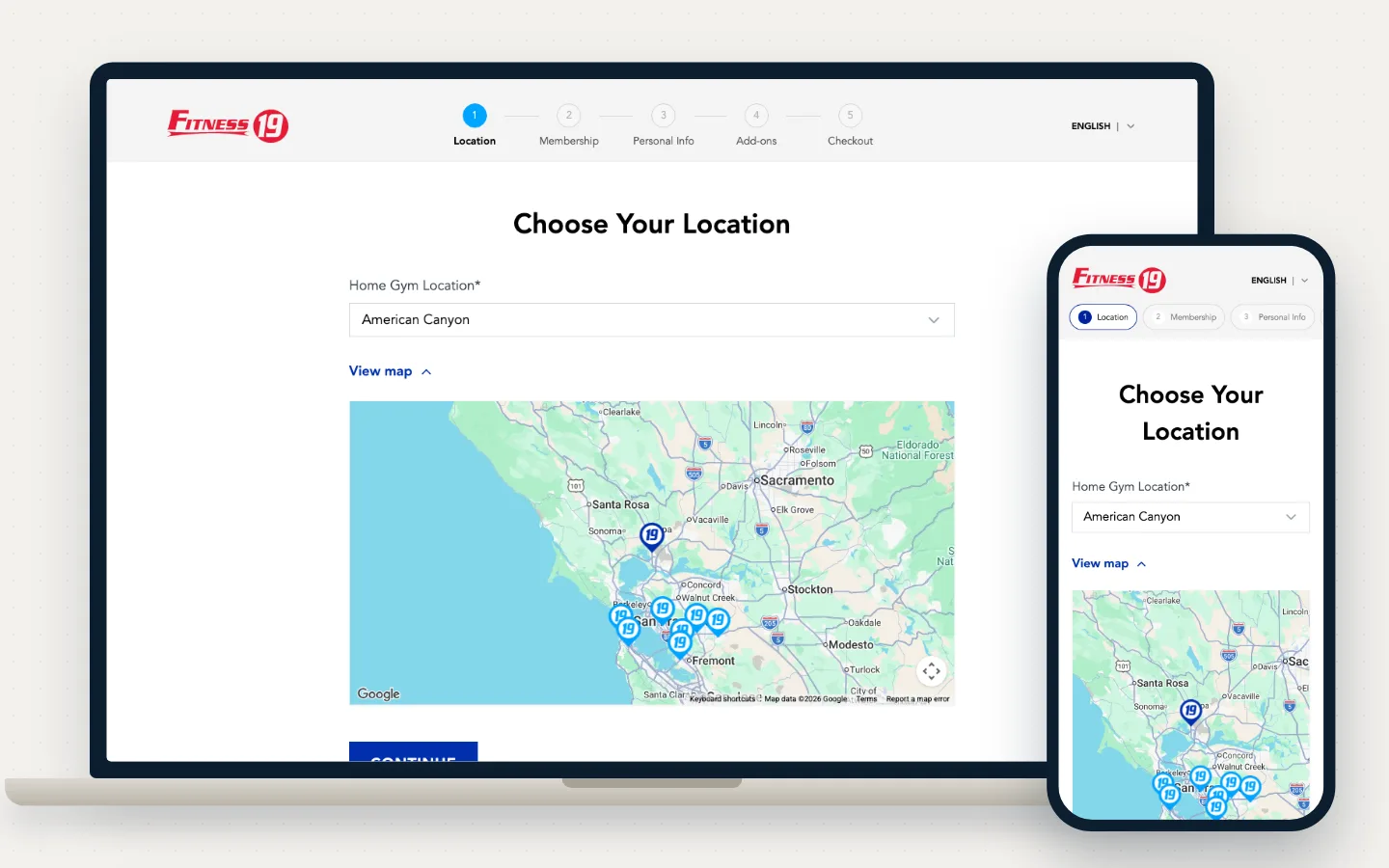
We rebuilt the five-step Join Online app, covering location, membership, personal information, add-ons and checkout, and launched it on both brands on December 9, 2024.
Pricing moved into HubDB tables the client controls. A locations table holds each club’s base prices, and a sales table holds the current sale per location, its promo code and an inclusive end date. The page shows the HubDB base price struck through only when it is higher than the live price from ABC, so every discount a visitor sees is one ABC will honor. Plan cards carry a “Best Value” or “Most Popular” banner based on the plan type, and a plain price description per plan and commitment length comes from the same tables.
The rebuilt flow added address autocomplete, improved accessibility, and deep links to any step, so a promo email can land a visitor at the membership step for their club. A membership preview module embeds the same plan cards on the homepage and on every location page, with a promo code field and a link straight into the flow. When a visitor declines location sharing, every location-aware module asks them to pick a club first. The commitment length defaults to whichever option has the most plans at that location.
Because plan visibility is driven by keywords in ABC plan names, the client’s own team can introduce a new plan, a third membership tier, a sold-out card or a towel-service variant by naming the plan in ABC and filling in a HubDB row. Amenities, tooltips, holiday hours and “coming soon” labels for new clubs are all HubDB columns too.
For the 2025 sales project we built two applications on the platform:
- A check-in waiver. A multi-step HubSpot form with a selfie capture that creates a Waiver record associated with the contact. Each location has its own page, generated from HubDB, so a QR code at the front desk opens the right club. A kiosk mode refreshes itself between visitors, and a mobile mode works from a phone.
- A schedule-a-tour app. Staff set each location’s availability in the module, with HubDB holiday overrides. A booking creates an Appointment record in HubSpot through a serverless function, and the visitor gets an add-to-calendar button. A workflow sends each lead a unique link, and standalone booking pages live on both brands’ sites.
Alongside these we set up the SMS integration with Sinch, with teams per location, and the opt-in and opt-out workflows for email and text on both brands.
What They Got
The marketing team can run a sale at any number of clubs by editing a table. A new plan appears on the site when it is named correctly in ABC. A visitor can join from a phone, from an email link or from a location page, and the price they see is the price ABC will bill.
New visitors sign a waiver at the door or from a text, and leads book their own tours. Both land in the CRM as records tied to the contact, where the sales team works them.
Wrapping Up
The standard on this job was to put every variable the client changes often into a table they own, and to keep the billing system as the single source of price. Lynton now builds AI-native websites on open infrastructure; see our current work at /case-studies.