Heavy Duty Transaxle rebuilt its website on WordPress to match the brands it carries
The Customer
Heavy Duty Transaxle sells and rebuilds axles and transmissions for heavy equipment. They carry current lines from AxleTech, Meritor, Kessler and SISU and keep obsolete Clark, Rockwell and Schuler parts in supply, alongside a rebuild center and a service operation.
Their existing website carried a lot of that information, spread across many short pages. In spring 2022 they asked Lynton for a redesign.
The Challenge
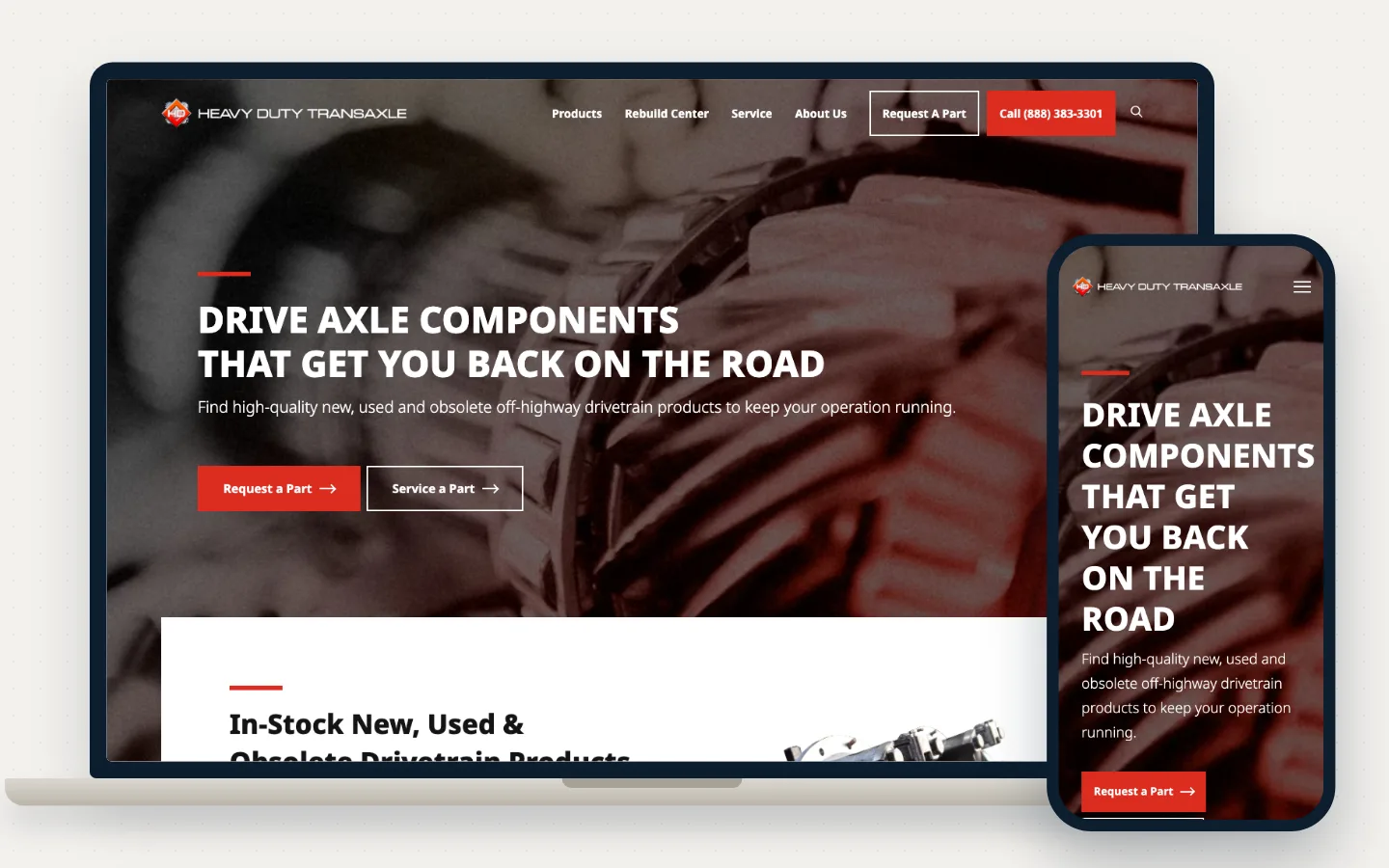
The brief was short. They wanted a site that was “clean, modern, and sophisticated” and that reflected the big-brand parts they sell.
Their content needed the same treatment. Product information sat on many thin pages, with the same equipment and brand descriptions repeated from one page to the next. The AxleTech range alone ran to about 17 sub-pages. The existing copy was short in places and needed reviewing and expanding, and the client wanted help with both.
The Solution
We started with the sitemap. We reviewed the existing pages in Google Analytics to see which were working, which needed improvement and which duplicated each other, then mapped the header and footer navigation from that. The site would be organized around the brands they carry and the industries they serve.
Four core templates were wireframed and designed for desktop and mobile, along with global styles, the header and the footer. The homepage carries a click-to-call button in the header, a products showcase, previews of the Rebuild Center and Service pages and a featured products slider. The About template has a Meet the Team module, links to product information sheets and a contact form.
The Products Index is a grid of brand logos, one for each of the seven lines, with a call to action that reflows as brands are added or removed. A Featured Products module is curated once and shared across pages, and a Recent Projects feed pulls from the blog.
The Products Interior template does the heavy lifting. It has an optional sticky sidebar menu, used on the AxleTech pages, a vertical tabbed module holding up to nine industries with the equipment and brands for each, a table module for axle models, descriptions and carriers, and a multi-column FAQ expander. The charts in the FAQ expander reflow on a phone with no sideways scrolling.
Content was as much of the job as design. We interviewed the client’s subject matter expert, then proofed and expanded the Home, About, Rebuild Center and Products Index copy and wrote short blurbs for each brand line. The AxleTech sub-pages were consolidated into fewer, fuller pages with an anchor-link mini navigation on each, and phrasing that had repeated from section to section was moved to the page introduction. Title tags and meta descriptions were written from the client’s keyword list and a SEMrush list, and set up through Yoast SEO.
A Request a Part landing page and form give buyers a direct way to ask for a specific part. We sourced 15 stock images for the industry tabs, recreated ten brand logos in white and treated the team photos. Roughly 44 pages were built and entered, with images resized and compressed.
After two rounds of user acceptance testing the site launched on September 28, 2022, about five months after kickoff. Before launch we crawled both the staged site and the live site and defined redirects for every address that moved. Google Analytics, Tag Manager and Search Console were set up, and the client had a one-hour training session so they could update the site themselves.
What They Got
A site organized the way their buyers think, by brand and by industry. A buyer looking for an AxleTech axle lands on a page with a sidebar for that range, a table of models and carriers, and a form to request the part. The team can add a brand to the index, curate the featured products, or post a recent project to the blog and see it on the products page.
The return in 2025
Nearly three years after launch, Heavy Duty Transaxle came back. They had two programs to promote, a Fast Track program and a training program, and wanted the site to make the difference between parts and assemblies clearer. We wrote a technical scoping and strategy document with a revised sitemap, planned the architecture and navigation, and set up the SEO and sitemap to cover Bing as well as Google.
Six pages were designed in Figma and built on the existing site: the Fast Track Program page, the Training Program page with a video, a Gallery page, a Rebuild Center page rebuilt with value propositions, authorization status and inventory, a Services and Programs overview and a Transmission Services page. The homepage was refreshed alongside them, and request forms were added for the two programs. The work went live on September 9, 2025.
Wrapping Up
Our standard on a redesign is to build the sitemap from what the data says is working, consolidate pages only where the content is thin, and keep every address that already works with a redirect for any that move. A client who returns years later for more is the simplest proof that the first build held up. Lynton now builds AI-native websites on open infrastructure; see our current work at /case-studies.