ConnectiveRx moved pdr.net to HubSpot CMS with its drug database in custom objects
The Customer
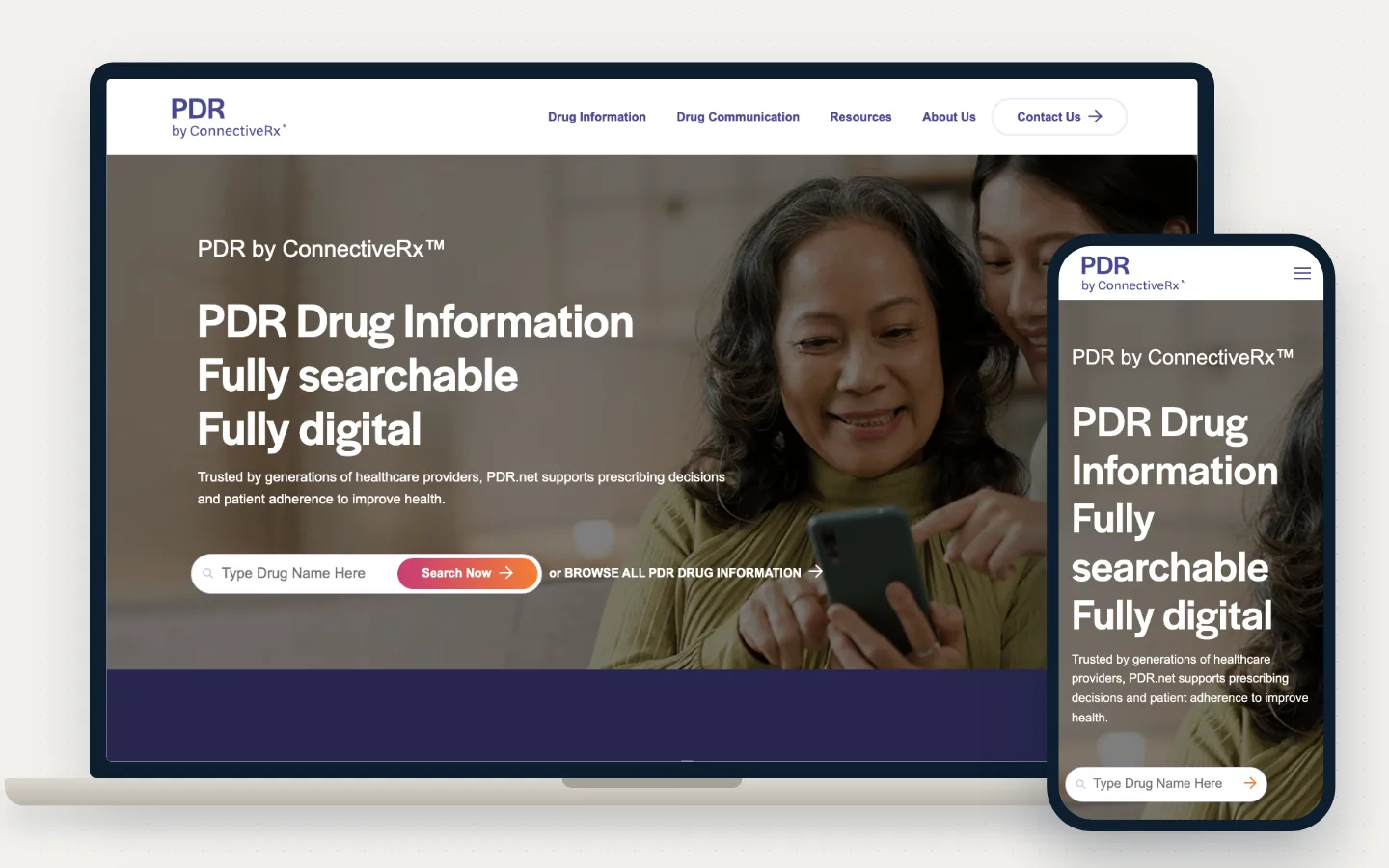
PDR, the Physicians’ Desk Reference, is a drug information site for prescribers, owned by ConnectiveRx. The site publishes drug listings, full prescribing information, and drug safety communications, along with a mobile app and a membership for healthcare professionals.
Before this project, pdr.net ran on its own platform with the drug data served from ConnectiveRx’s Corporate API. Visitors could browse drugs by name, read prescribing information, and view drug alerts carrying the mandated warning graphics. ConnectiveRx wanted the whole site on HubSpot CMS, and they wanted the drug data to come with it.
The Challenge
PDR.net is a reference site. Its value is a large, regularly updated drug database, and that data lives in an API ConnectiveRx controls. Moving the site to a marketing CMS meant finding a way for the CMS to hold and render that data on its own.
The site also had existing links and bookmarks pointing at addresses built from query strings, such as a drug label id in the URL. Those addresses needed to keep working after the move.
Beyond the data, the site needed a sign-in for its membership, ad placements, drug alert pages with their warning graphics and attached PDFs, and the monthly labeling update tables PDR also sends to customers. All of it had to be editable by the ConnectiveRx team after launch.
The Solution
We built pdr.net on HubSpot CMS with a data integration underneath it, so the drug database lives in HubSpot custom objects and the site’s templates render from those objects.
Design started from our starter theme, with global styles in light and dark variants. We designed and built seven templates: a homepage, a flexible inner page, a drug information listing, a drug information detail page, a drug summary, a drug communications listing, and a drug communications detail page. The homepage carries a multi-step questionnaire built as a HubSpot form, with each question a step and optional contact details on the final step. The flexible inner template carries the rest of the starter modules plus a new image slider.
The integration pulls from the ConnectiveRx Corporate API into custom objects in the HubSpot CRM: drugs, drug alerts, attachments, REMS summaries, and the associations between an alert and its related drugs. It handles hidden labels, long text properties split to fit, and HTML text fields.
The dynamic pages read from those objects. The drug listing offers alphabet navigation, search, pagination and a new drug-class filter. The detail and summary templates include a field repeater, so editors choose which fields show on a summary, with collapsible sections and a sidebar kept in the required order. Full prescribing information pages pull the brand and generic names from the associated drug object, show a highlights section and product images, and keep the label’s sections in the order they appear in the label, with a simplified single-section layout for dietary supplements. Hidden labels are reachable only by their exact address.
Drug communication pages load an alert and its associated objects from the id in the URL, embed the HCP letter, fact sheet and prescribing information PDFs, show the severity warning images, and include print and share buttons with a print stylesheet.
Our standard on a migration is to keep every address that already works. We reworked all of the dynamic templates to support PDR’s existing query-string URLs instead of HubSpot’s own dynamic page addresses, so a link to a drug label id resolves on the new site the way it did on the old one. Redirects covered the rest.
We set the site up for HubSpot Memberships, with a login bar in the global header, reproduced the monthly labeling update tables as an option in the tabbed content module, entered up to 15 pages of content including policy, terms and membership pages, and moved several footer links up into the top navigation. The site went live at noon Eastern on August 28, 2023, with the PDR team updating DNS on a call with us, and we handed over documentation covering the dynamic templates.
What They Got
The ConnectiveRx team now runs pdr.net from HubSpot CMS. The drug database syncs from their own API into the CRM, and the drug, label and alert pages render from that data directly.
Editors control what a drug summary shows, publish labeling update tables through a standard module, and build new pages from the flexible template. Visitors still find drugs by name or drug class, and the addresses PDR had already been sharing still land on the right page.
Wrapping Up
On this job our standard was a reference site’s data living in the CMS as data, and every working address kept through the move. Lynton now builds AI-native websites on open infrastructure; see our current work at /case-studies.