Poll Everywhere moved its Rails site and WordPress blog into HubSpot CMS
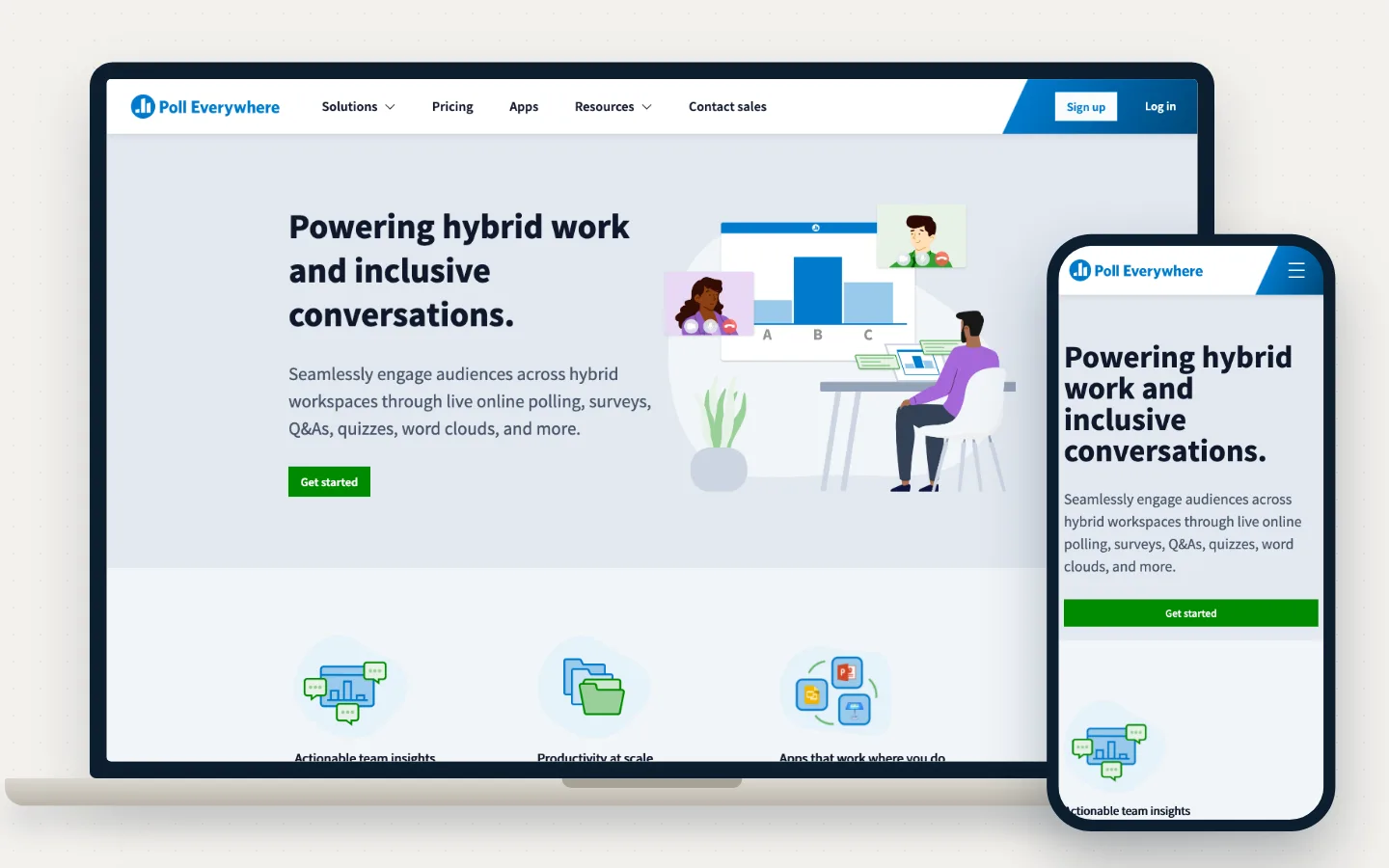
The Customer
Poll Everywhere makes live polling and audience engagement software. Its plans serve businesses and non-profits, higher education, K-12 schools and one-time users, and its software plugs into tools such as Slack and Google Slides.
Before the project, Poll Everywhere’s marketing site was a custom Ruby on Rails application. The blog lived on WordPress, email ran through Pardot, and the sales team worked in Salesforce. The company runs several subdomains, and only the main marketing site and the blog were in scope for the move.
The Challenge
Poll Everywhere was bringing its marketing site, its blog and its marketing automation together on one platform. That meant moving the site and the blog into a CMS its marketing team could run, and setting up that platform’s marketing tools alongside the CRM the sales team already used.
Poll Everywhere also wanted to keep control of its domain and its infrastructure. It planned to keep its own reverse proxy in front of the new site and to run the final cutover itself.
The site had to move as it was, a like-for-like migration into the platform.
The Solution
We rebuilt the site in HubSpot CMS on the starter theme, with global styles, a header and a footer to match the existing site. From there we built 12 page templates. A homepage with hero, featured content, logo slider, two-column media, video, resources and CTA modules. An applications pillar page that collects the downloads for each platform. A HubDB landing template with filtering tabs for webinars, videos and case studies. A flexible inner page with vertical tabs, card features, testimonials and forms. A pricing table with a sub-menu for four plan levels (business and non-profit, higher education, K-12 and one-time use) and a monthly or annual toggle. An international landing page with horizontal tabs. Templates for fact sheets, features, legal pages, sign-up and contact sales. And blog listing and post templates with a secondary filter for seven categories, from product updates to engineering and culture.
Each template went through a developer code review and a cross-browser review before acceptance. Our team then entered 115 pages, including 13 feature pages, 11 application pages, four fact sheets, five legal pages, ten parent pages and 72 resource pages. The WordPress posts came across with the platform’s automated blog import.
We designed and built a custom email template to match the site, with related resources, featured text, stats, list, columned content and CTA modules, and tested it in Email on Acid before handover.
In parallel, we delivered a Marketing Hub Advanced onboarding. That covered the foundations of the portal, segmentation, data import, a Salesforce strategy with field-mapping cleanup, a security and compliance review, engineering configurations, lifecycle stages, workflows, forms, landing pages, CTAs, and reports and dashboards, delivered as a series of working sessions.
Two client training sessions, written documentation and two rounds of UAT fixes followed, including the skinned system pages. When Poll Everywhere was ready to cut over, we set the canonical URL on every page to the polleverywhere.com domain so that the site would be indexed correctly behind their reverse proxy, and advised on adding their Source Sans Pro brand font to the email template. Lynton prepared the site, and the client’s team ran the launch.
What They Got
Poll Everywhere’s marketing team can now build and edit pages from a set of templates and modules, publish blog posts in the same editor, and send email from the same platform where their contacts and forms live. The pricing pages, application downloads and resource pages all run on templates the team controls.
The marketing database is connected to Salesforce with cleaned-up field mappings, so leads and lifecycle stages flow between marketing and sales. And the company kept its own reverse proxy and domain in front of the site.
Wrapping Up
Our standard on a migration is to move what works, keep the client’s control of their domain and infrastructure intact, and hand the site to a team that can run it on their own. Poll Everywhere’s own team ran the launch on a site that was ready for them.
Lynton now builds AI-native websites on open infrastructure; see our current work at /case-studies.