Relo Metrics launched its rebrand on a new HubSpot CMS site with every page rewritten
The Customer
Relo Metrics measures the media value of sports sponsorships for brands, teams and agencies. Its platform tells a sponsor what its exposure was worth.
The company had recently rebranded. Its website predated the rebrand, and its blog ran on a separate subdomain. The team wanted a site that showed the new brand from the first screen.
The Challenge
Relo Metrics had a new name and a new story, and its website told neither. In the discovery brief, the client wrote that “it is critical that the Relo brand and messaging is delivered (via our website) with sharp, bold, clear and consistent value to the customer.”
They asked for all of the copy to be written fresh, and for the homepage to lead with their story. The site was to be built on HubSpot’s starter theme with a small number of custom pieces.
Their resources library lived on a subdomain and was staying there. The new site still needed a resources page that visitors could filter.
The Solution
We redesigned and rebuilt the site on HubSpot CMS, rewrote every page, and launched it on May 1, 2024.
Strategy first. We reviewed their Google Analytics data to plan the sitemap, then ran keyword research. The client chose “sponsorship measurement platform” as the homepage keyword, and that phrase shaped the homepage title.
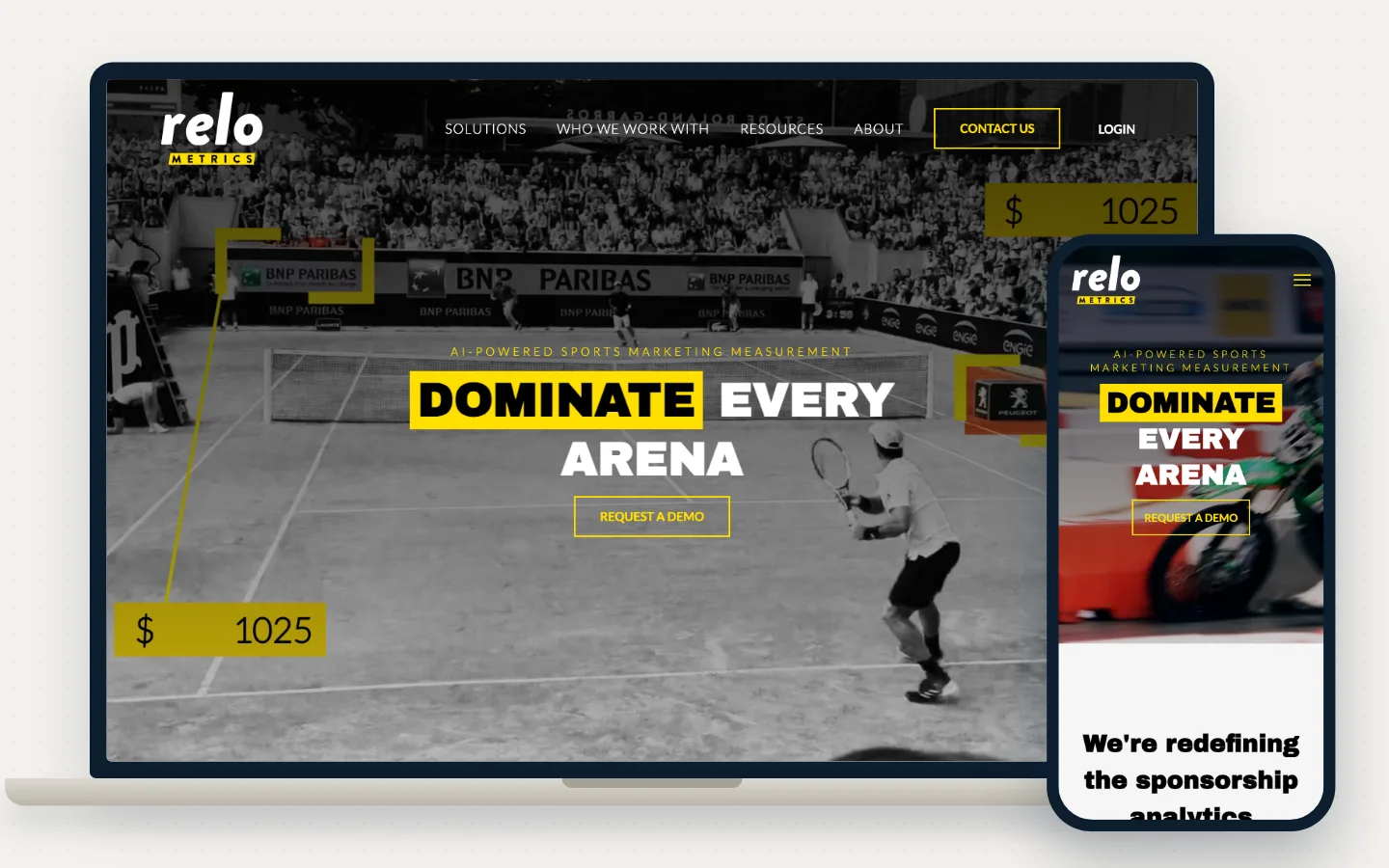
Seven template designs. We designed a homepage, an about template, a contact page, a flexible inner template, a blog listing, a blog post and a custom resources template. The about template became the base for the Culture, Team and Our Story pages. The contact page works as a landing page, with the footer navigation removed. The homepage went through two client revision rounds and finished with a background video in the hero.
The design carries the brand’s details: a stacked logo in the header, a subtle login button, a pink brand accent in the call-to-action bar, Archivo and Lato type, a stats module and a testimonial slider. The teams module shows black-and-white player photos that swap to a color background on hover. On the blog, a featured post sits at the top of the listing, and each post shows its author and an optional call-to-action button.
Copy rewritten from interviews. Our copywriter interviewed the VP of product marketing, the VP of client services and the product marketing manager, then wrote the site in batches: Home, Story, Team, Culture and Careers; Platform, Signals, Insights, Contact and Press; Brands, Teams, Agency, Partners and Media. A Technology Overview page was added mid-project when the team saw the need for it.
Development on the starter theme. Global styles include a scroll-triggered highlight animation on headings, so the editor can mark a phrase and see it animate on the live page. The resources page is driven by a HubDB table that we populated from their existing library, so visitors filter resources on the new site and read them where they already lived. Every template passed design review, code review and cross-browser review before content entry.
Launch. We entered the web page content and the case studies, ran a UAT survey with the client, and worked through two rounds of UAT fixes. On launch day the client added the DNS records, we switched the existing blog to the new templates, published the Press blog, stood up the account pages and put the redirects in place. We handed over documentation and ran a one-hour training session the following week.
What They Got
Relo Metrics now has a website that shows its name and its story. Every page carries copy written for the new brand, from interviews with the people who sell and support the product. The marketing team edits pages built on the starter theme’s modules, adds blog posts with a featured post and author shown, and keeps the resources page current by editing a table.
No traffic or lead figures were recorded for this engagement, so we make no claims about them.
Wrapping Up
Our standard on a rebrand is that the words get the same attention as the design. We interviewed the people who know the product before writing a line, and we kept the build on a standard theme so the client’s team owns the day-to-day editing. Lynton now builds AI-native websites on open infrastructure; see our current work at /case-studies.