Selerant rebuilt its website on HubSpot CMS around the visitor's role
The Customer
Selerant made product lifecycle management, regulatory compliance and EHS software for companies in food and beverage, cosmetics and specialty chemicals. It sold three product lines, Devex PLM, Compliance Cloud and Hazex EHS, to buyers in three industries, and each buyer arrived with a different job to do. Selerant later became part of Trace One.
When Selerant came to us in 2021, its resources section was a catch-all built outside HubSpot and its glossary was an accordion module fed from a blog.
The Challenge
Selerant’s marketing lead worried that the site read as a PLM company. A visitor from a cosmetics compliance team and a visitor from a chemicals safety team landed on the same page and saw the same pitch. The site could tell a visitor who Selerant was only once it knew that visitor’s role.
The content was the other problem. Blog posts, landing pages and case studies sat in different places, and the client wanted one library a reader could filter by solution, industry and content type.
The company was also planning multilingual pages, evaluating contact enrichment tools for North America and Europe, and selling into EU markets where consent rules differ by country. Each of those called for a site that marketers could reconfigure themselves.
The Solution
We ran discovery before design. Over eight discovery calls we produced a competitor analysis covering 12 competitors across the three product lines, website goals, a user ranking, a sitemap, a data flow, content outlines per template, and lead scoring and lifecycle stages. That work became the strategy deck the site was built from.
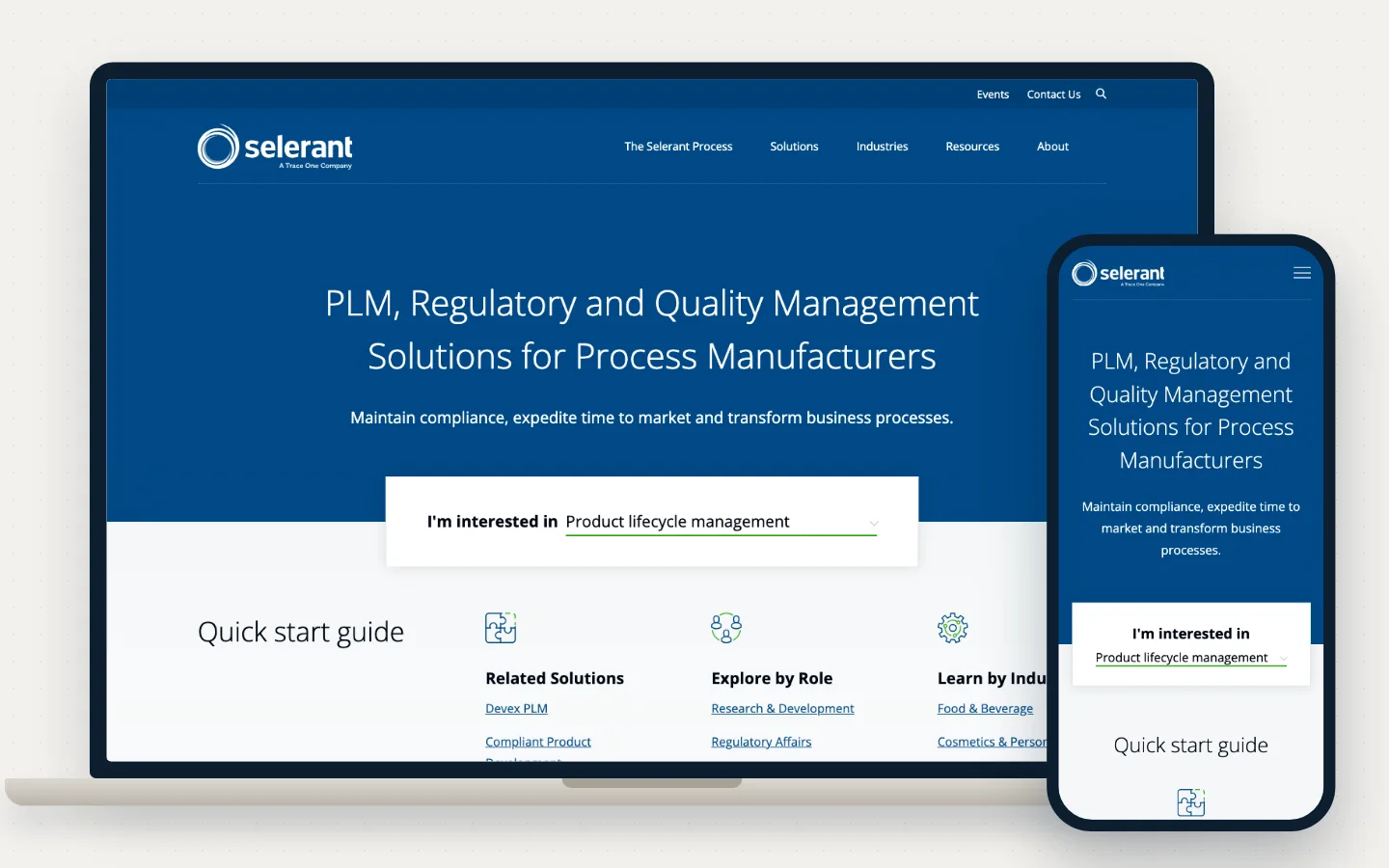
The homepage was built around an “I’m interested in” drop-down. The visitor’s choice filters the related solutions, explore-by-role and learn-by-industry module beneath it, and the testimonial, process, feature and contact-form modules further down. Before launch we also passed that choice into a hidden form field, so a submitted form carries the interest the visitor declared.
We built the site as a set of templates and complex modules. The products template has a stage-gate process module with a short video clip per stage, an industries bar editable per product, and mini-demo tabs that jump to chapters of a single Wistia video. Industries and case-study templates carry hand-picked case studies and a “solutions utilized” module. The contact template filters by continent and then lists countries, split into Selerant offices and implementation partners.
The resources library runs on HubDB. It aggregates blog posts, landing pages and case studies tagged by solution, industry, type and topic, with multi-select columns, scheduled publish dates, extra search keywords and an inactive flag. Each language can point at its own source table. Resources can be gated: on the products page, a click on a resource in the hero opens a modal with a preview image and a request-access form. We mapped the previous blog export to the new URLs and loaded it into the library.
The glossary was rebuilt on HubDB so terms can be imported in bulk, with a global call to action block that editors can swap. The careers template pulls open positions from a HubDB table, filtered by location, job category and work type, with an Apply Now link to Workday or LinkedIn.
Two product tools came late in the build. The Compliance Cloud coverage map is a world map module, reusable across pages, where editors define limit categories, additive and contaminant sub-filters, and three to five document-coverage levels, each with a color and its assigned countries. The Hazex ROI calculator is a multi-screen module built from the client’s own formula sheet. It estimates the time saved on Poison Centre Notification and UFI work, and editors can change the jurisdictions, difficulty factors, minutes per service, product categories, question wording and results copy. It ends in a book-a-demo form.
Forms followed a lead-scoring strategy, with webinars and newsletters at the top of the funnel, product assets in the middle and trial requests at the bottom. US versions of the forms omit the GDPR opt-in and are served by a smart rule based on the visitor’s location. The header and mobile menu were designed with a place for the platform’s language switcher.
Before launch we trained the client’s team, delivered documentation, and ran four rounds of UAT. The site went live on September 16, 2022.
What They Got
Selerant’s marketers could change what a visitor sees by role and industry, add a term to the glossary or a job to the careers page, gate a download, and recolor a regulatory coverage map, all from the editor they already used. The ROI calculator and the coverage map were product tools they owned and could tune as regulations and services changed, and the resource library could take a separate table for each language.
Wrapping Up
Our standard on this job was to build every module so the people who run the site can reconfigure it themselves, and to settle the strategy in discovery before anyone drew a screen. Lynton now builds AI-native websites on open infrastructure; see our current work at /case-studies.