Trevecca Nazarene University moved trevecca.edu from ExpressionEngine to HubSpot CMS
The Customer
Trevecca Nazarene University offers traditional undergraduate, graduate, adult studies and online programs. In 2021 its blog already ran in HubSpot, while the main trevecca.edu site still ran on ExpressionEngine. Campus events lived in Ad Astra, the university’s scheduling system, and were not shown on the website.
Lynton already knew the university’s systems. That same year we expanded the connection between its HubSpot portal and its Microsoft Dynamics recruitment CRM so that graduate admissions deals and opportunities moved between the two.
The Challenge
Trevecca wanted the whole site in one place. The News section needed to become a blog alongside the existing one. Faculty pages and program pages needed to move into data tables, so the marketing team could update a row instead of editing a page, and they wanted a Find Your Degree finder built over the programs data.
The old site limited them to a fixed set of colors. That mattered most for the announcement bar, which carried COVID alerts and campus lockdown notices and needed to change color with the message.
The design brief was simple. Outside the brand guides, nothing on the current site was to influence the new design.
The Solution
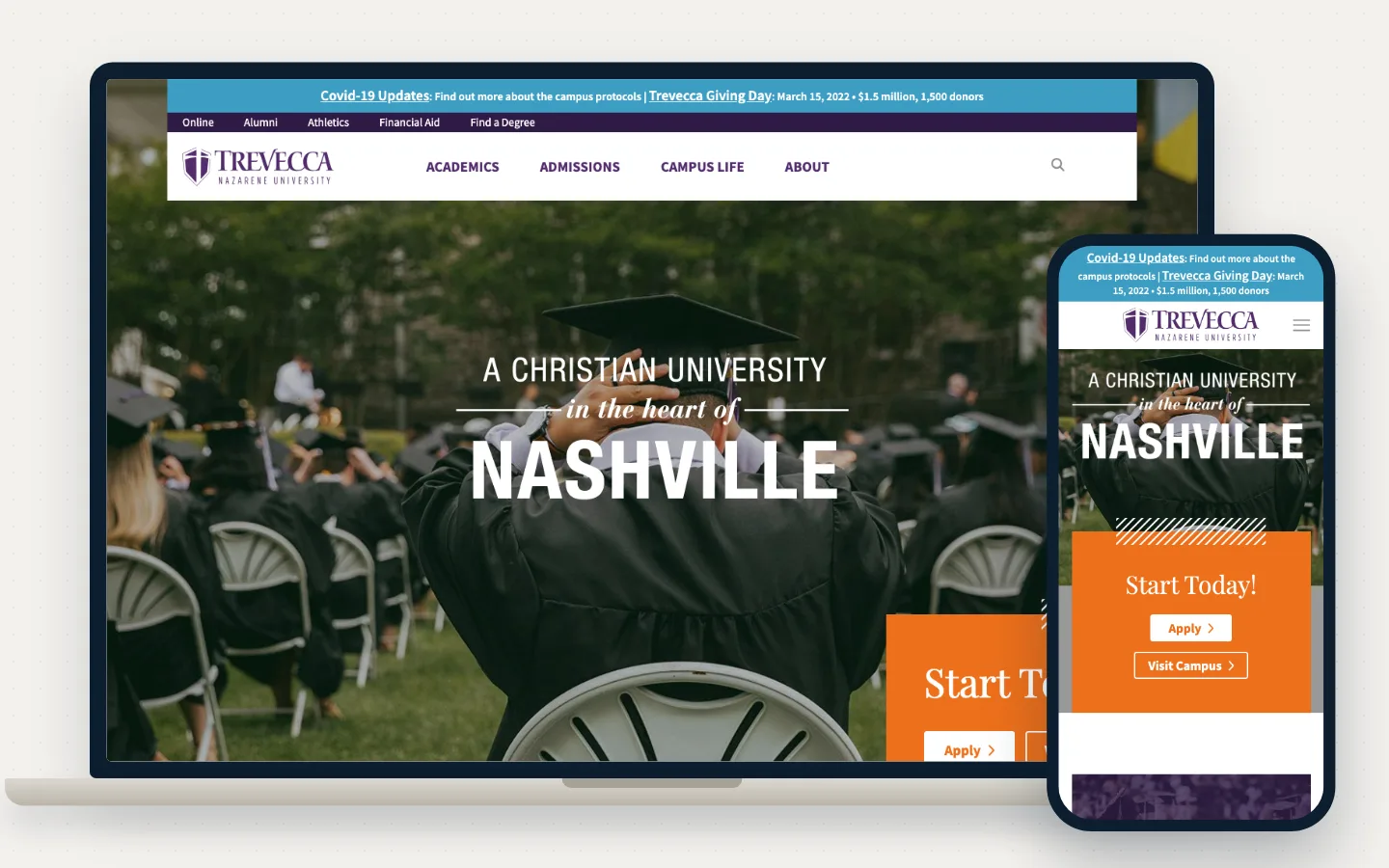
We designed nine page templates and built them as drag-and-drop templates in HubSpot CMS: Homepage, Academics, Undergraduate, Online, TNU Experience, Giving, Programs (with and without tabs), Find Your Degree and the blog listing and post, plus dynamic detail pages for events and faculty. Global styles, a header with a mega menu, site search, a mobile menu and the footer came first. The announcement bar got editable colors, fonts and icons, with the light blue darkened to meet ADA contrast.
The programs live in a HubDB table tagged by program, interest and field of study. The Find Your Degree finder reads from that table and can be pre-filtered from the Academics page or on any page it is placed. Each program page pulls in upcoming start dates, an information session call to action, faculty filtered by department, careers, testimonials and FAQs. A second table holds the faculty, with an alphabetized index filterable by department and a detail page for each person.
We scripted the content migration out of ExpressionEngine. News posts went into the new blog. Faculty and program records were extracted into spreadsheets and imported into the tables.
For events, we built a one-way integration from Ad Astra into a data table, with an event type field for filtering, times converted from UTC to local, a historical sync and a calendar module with featured, list, single-day and calendar views. The TNU Experience template got an Instagram feed.
Content entry was split: Lynton staged the top-level and section pages in batches of 15 and 30, and a content team entered up to 120 program pages, with every slug matched to the existing URL. We mapped redirects from a crawl comparison of the old and new sites, ran two rounds of user acceptance testing and launched on February 2, 2022, about six months after kickoff.
What They Got
Trevecca’s marketing team can add a program, a faculty member or an event by editing a row in a table, and the finder, the directory and the calendar update themselves. The announcement bar changes color with the message. The site, the blog and the news all live on one platform.
The relationship kept going. Over the next two years we added HubDB-driven modules to the same site: a programs listing that can be pre-filtered by level in the editor, a standalone marketing events calendar, a testimonial slider, a news module with a featured story, an alternate landing page header and footer, a filterable resources listing and a course catalog module. The catalog mattered because the university’s academic catalog was an external site that couldn’t be changed once published. The module lists course name, number, credit hours and description on the program page itself. In early 2024 we built a featured faculty slider that pulls program-tagged faculty onto about 80 program pages.
In 2024 Trevecca asked for a second site, an online version of its printed alumni magazine. We built it on our starter theme in the same portal, with a darker, more muted palette so it reads differently from the flagship site. It has an events highlight module linked to Eventbrite, a resources listing with gated content, blog templates that pull tagged stories from the main site, and an event landing page template with an agenda, speakers, a countdown, a ticket embed and a sponsor wall. We entered up to 25 pages and launched it on August 1, 2024, about three and a half months after kickoff. In February 2025 the alumni modules were ported back to the main site.
Wrapping Up
The standard on this job was that every piece of repeating content, meaning programs, faculty, events and courses, lives in a table the marketing team owns, so the site grows from the editor rather than from a developer’s queue. Four years of additions sat on that footing. Lynton now builds AI-native websites on open infrastructure; see our current work at /case-studies.