A sales training franchisor connected its 165+ franchise HubSpot portals
The Customer
Our client is a global sales training company that sells through a network of more than 165 franchises. Each franchise is an independent business with its own HubSpot portal. Corporate runs a separate portal for its own sales, marketing and franchise development teams.
In 2021 we moved the corporate CRM from Microsoft Dynamics into HubSpot, bringing contacts, accounts, opportunities, activity history and record owners across. That corporate portal is the hub of everything described here, and the connection it anchors later carried the lead router we built inside HubSpot.
The Challenge
Corporate wanted the franchise network to work from one playbook while each franchise kept its own portal.
Every franchise portal needed the same sales pipeline and the same core properties, so a deal stage or a field meant the same thing everywhere and corporate could report across the network. Some franchises needed exceptions to that standard. Corporate needed to send leads and referrals into the right franchise portal and to see where a contact stood across the network. Corporate’s own teams also had to move into the corporate portal: franchise development from an older portal, and corporate marketing from Keap.
All of it had to be something corporate’s admins could run day to day across the whole network.
The Solution
The connection runs on SyncSmart’s Portals app, a HubSpot app each franchise installs in its own portal. Working with SyncSmart, we configured it for this network, built the controls corporate asked for, rolled it out to the franchises and connected the systems around it.
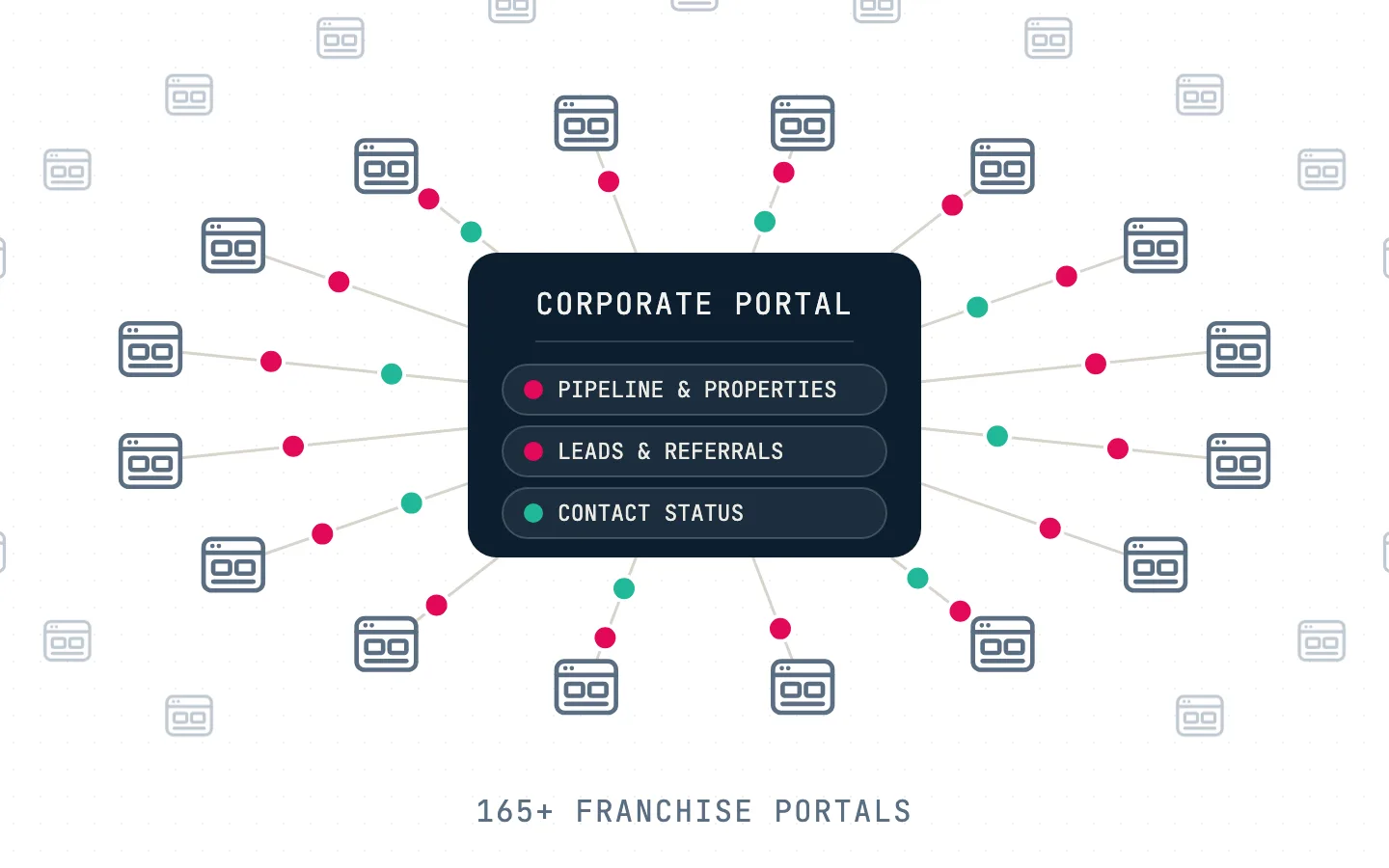
A standard that arrives with the install. Corporate keeps its standard properties and pipelines in one governing spreadsheet. When a franchise installs the app, its portal gets the standard sales pipeline and the properties on that list, and only those. Changes to the shared properties and pipelines go out the same way.
Controls corporate can run. Two switches turn property and pipeline syncing on or off for the network, and an exception group lets a set of franchise portals take a different version of the standard. We built two forms behind them: one assigns franchise portals to the exception group, and one sets the switches for every connected portal at once. Each franchise’s install date and HubSpot subscription tiers are written back to the client’s franchise roster, so corporate can see who is connected and on what plan.
Rollout and support. We built a training portal for franchisees on HubSpot with an FAQ, step-by-step videos, install instructions and a shared webinar link, then supported franchises through installation in four waves between October and December 2022. In 2023 we added a sync health dashboard that shows corporate admins the open sync issues for each franchise portal and a list of new installs with their dates and subscription tiers.
Corporate teams in one portal. Franchise development’s records lived in an older portal. We set the app to bring them into the corporate portal by record owner, so the team moved over in planned groups, and set up its pipelines, reporting, playbooks, permissions and training there by January 2023. In 2023 we brought corporate marketing’s contacts and data over from Keap, and corporate marketing launched in the corporate portal in November 2023.
Traffic between corporate and the franchises. Leads that corporate assigns are synced into the chosen franchise’s portal, and referrals are tracked the same way. Disqualified leads from the client’s separate enterprise sales portal flow to the corporate portal so the franchise network can work them. A network contact status process checks the franchise portals and writes one status onto each corporate contact, so corporate can see where a person stands across the network. A historical sync brought existing franchise records into the corporate portal, tested with the client in production before sign-off.
The training system and the data lake. Customers from the client’s learning management system sync into the portal of the franchise they belong to, using a location ID scheme we designed, and that sync went live in three waves in early 2024. A nightly job sends contacts, companies and deals from the app’s reporting store to the client’s data lake as dated files.
What They Got
Every connected franchise portal starts from the same pipeline and properties, defined once at corporate, with an exception group for the franchises that need something different. Corporate admins change those settings from a form, track installs and sync issues on a dashboard, and see a network-wide status on each contact. Leads, referrals, training-system customers and reporting data move between corporate and the franchises, and corporate’s own teams work in one portal.
No figures on adoption, data quality or time saved were recorded, so we make no claims about them.
Wrapping Up
Our standard on a network build like this is that corporate sets the rules and each franchise keeps its own portal. We moved teams across in groups we could switch off, tested historical syncs with the client before relying on them, and gave corporate’s admins the controls to run the network themselves. Lynton now builds AI-native websites on open infrastructure; see our current work at /case-studies.